New Cat Starter Guide: A Timeline From Adoption Day to the First Few Months

Before You Bring Them Home: Prep Is Half the Game
You picked a cat. Maybe you met them at a shelter. Maybe a friend's cat had kittens. Either way, the carrier's in your hand and you're excited. That's good.
But the part nobody warns you about: the moment you walk through the door is not when the real work starts. It's the moment you stop doing the prep. And the first 24 hours, not the adoption day itself, are what actually decide how the next few weeks go.
Let me give you the full timeline, so you're never guessing what comes next.
Adopt, Don't Shop — and Know What It Actually Costs
If you haven't adopted yet, start here. Roughly 3 million cats enter U.S. shelters every year, alongside about 2.8 million dogs [1]. Around 2.2 million cats get adopted, but about 277,000 are still euthanized each year [1]. Adoption isn't just the cheaper option — for a lot of cats, it's the only option.
On price: shelter adoption fees in the U.S. usually run $50–$150 (an average range, not a fixed price), and that fee often already covers spay/neuter and at least some vaccinations [7]. That's a real deal compared to buying from a breeder, where you'll often pay several hundred dollars and still handle vetting yourself.
But the fee is just the entrance ticket. The real budget is the first year. Estimates put the total first-year cost of a cat — supplies, food, vet visits, spay/neuter, the works — somewhere around $800–$2,000 [9]. That's a ballpark, not a promise. And it's before anything unexpected.
So before you bring anyone home, sit down with your budget. Not to scare you. To make sure you can say yes without stress.
Build a "Safe Room" Before Day One
Cats are territorial by instinct. A whole new house is overwhelming for them — everything smells wrong, every corner is unknown. The single most useful thing you can do is give them one small, quiet room to start in [2].
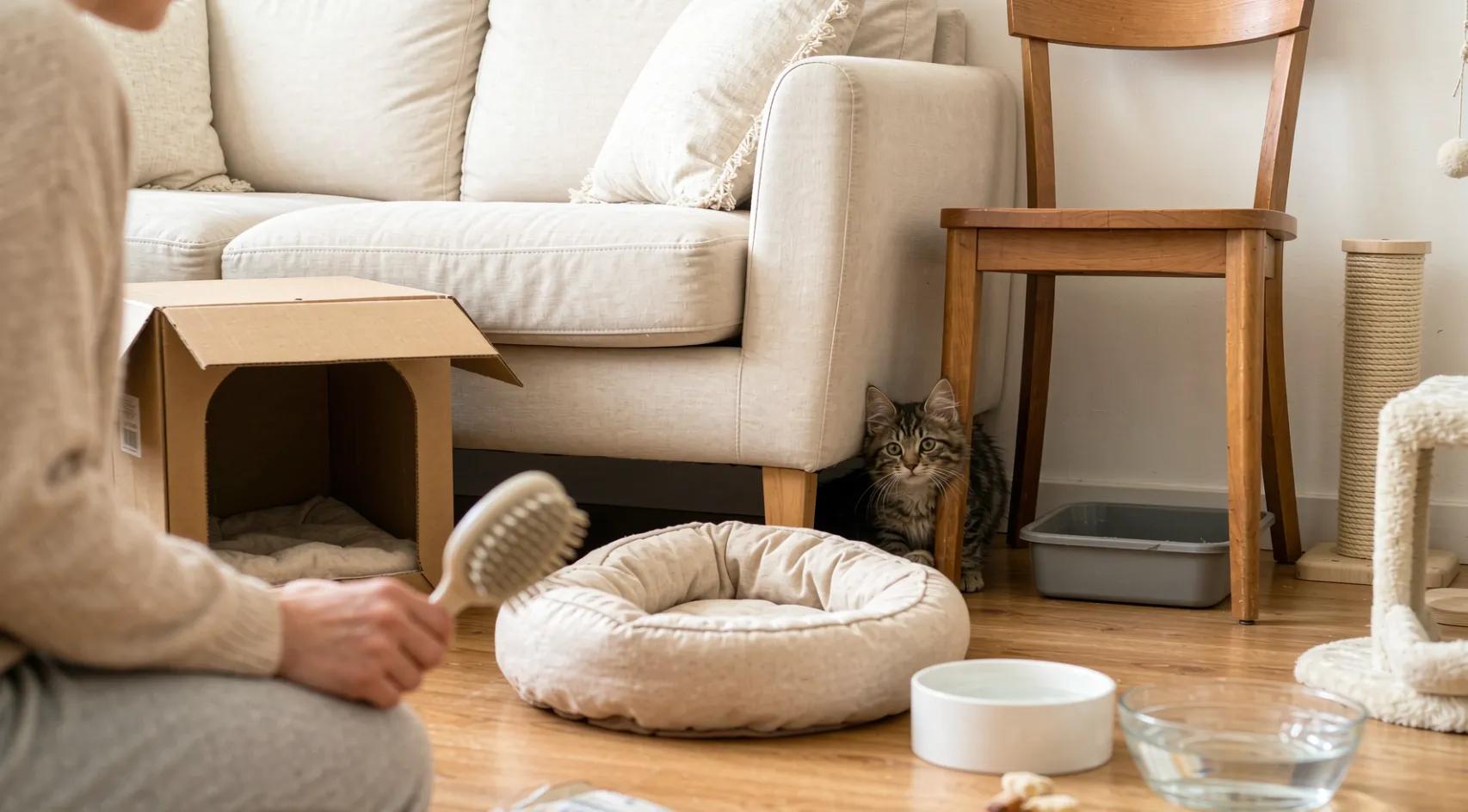
A bathroom, a spare bedroom, or even a walk-in closet that's been cleared out works. In that room, before the cat arrives, set up:
- Food and water bowls, in separate spots (cats don't like them side by side)
- A litter box, placed away from the food
- A bed or a box with a soft towel
- A scratching post
- A few toys
The ASPCA's own new-cat guidance keeps it simple: food, water, a clean litter box, a place to hide, something to scratch, a few toys [2]. You don't need a pet store haul. You need the basics done right.
Why a separate room? Because giving a cat a small, safe starting space dramatically lowers stress. It's easier for them to feel "this tiny corner is mine" than "this whole apartment is scary."
The First 24 Hours: Less Is More
This is the part most people get wrong. The cat comes home, and you want to hold them, show them around, introduce them to everyone. Resist that.
When you get home, take the carrier straight into the safe room. Open the door. Let the cat come out on their own terms. Do not dump them out, do not chase them, do not follow them around trying to pet them.
Expect this, and know it's completely normal: the cat will probably hide. Under the bed, behind the couch, in the back of a closet. That is not a sign you've done something wrong. That's a cat doing exactly what a cat does when things are unfamiliar.
Leave them be. Sit quietly in the room for a little while, maybe read or work on your phone. Let them watch you from a safe distance. Talk in a low, calm voice so they learn the sound of you without pressure.
A tip that works: let food, water, and the litter box be the thing that brings them out. When they're hungry, they'll come out to eat — even if they'd rather not be seen doing it. That's progress, even if it doesn't feel like it. I've sat through a few of those 3 a.m. feedings myself, pretending to be asleep.
The First Week: Routine Beats Intensity
After the first 24 hours, the goal shifts from "let them hide" to "start a rhythm." Cats are creatures of habit. Routine is calming for them — more than affection, honestly.
Set a feeding schedule. Kittens under about 8 weeks old are usually still on mother's milk or formula, but by 8–12 weeks they should be on solid kitten food, typically fed 3–4 times a day [4]. As they grow, that drops — around 6–12 months it's usually 2–3 meals a day [4]. Adult cats (over a year) do fine on twice a day.
Feed a complete, balanced kitten or cat food that includes taurine — an essential amino acid for heart and eye health [2]. And keep treats to no more than 5–10% of their total diet [2]. Treats are for bonding, not for meals.
Scoop the litter box at least once a day, and wash it with warm water and mild soap weekly [2]. A clean box is one of the most underrated things you can do to keep a cat happy and using it properly.
Book the first vet visit during this week. Even if they seem healthy, the first checkup catches things early and gets vaccinations started. More on that in a minute.
The First Few Months: Vaccines, Deworming, and the Big Decision
This is where the real medical timeline kicks in. I'll be honest: I didn't remember any of this off the top of my head the first time — I needed it spelled out, which is exactly what I'm doing below.
Vaccines. In the U.S., kittens typically start their core vaccines around 6–8 weeks old, with boosters every 3–4 weeks until the final dose, which should be no earlier than 16 weeks [3]. That core vaccine is called FVRCP (protects against feline herpesvirus, calicivirus, and panleukopenia). The rabies vaccine usually comes at 12–16 weeks, with a booster a year later [3]. A 6-month booster for FVRCP is often recommended too [3].
The takeaway: this isn't a one-shot thing. It's a series, spread over several weeks, and it needs to be planned with your vet.
Deworming. Kittens are commonly dewormed starting around 2–3 weeks of age, then every 2 weeks until about 8–9 weeks old, and then monthly until 6 months of age (per CAPC guidelines) [8]. Young kittens are very susceptible to intestinal parasites, so this is routine — not a reaction to a problem.
Spay/neuter. The ASPCA recommends spaying or neutering cats before 5 months of age [2]. Spaying a female before her first heat cycle has real long-term health benefits, including reducing the risk of some reproductive cancers [6]. This is a conversation for your vet, but 4–6 months is the common sweet spot [6].
None of this is something you diagnose or dose yourself. Your job is to follow the schedule and ask questions. Their job is to keep your cat healthy.

Know the Signs: What's Normal Adaptation vs. What Needs a Vet
This is the line you don't want to cross. Cats are masters at hiding illness. By the time something looks visibly wrong, it may have been going on for a while.
So the rule of thumb: if something persists, see a vet. Here are the concrete signals.
Normal adaptation (give it time): hiding, being shy, lower appetite for a day or two, sleeping a lot, being cautious around new people. These should improve within a few days to a week as they settle in.
Signs to call a vet:
- Not eating for more than about a day, especially for a kitten
- Vomiting or diarrhea that lasts more than a day
- Lethargy that doesn't lift
- Difficulty breathing, or breathing that looks fast or labored
- Using the litter box less, or straining to pee
- Any sudden change in behavior
For reference, a healthy cat's normal temperature is about 99.5–102.5°F, their heart rate is roughly 160–220 beats per minute, and they take about 20–30 breaths per minute [5]. But don't stress about measuring all this yourself — the simpler signals above (not eating, lethargy, breathing trouble) are the ones to act on.
One more thing that trips up new owners: if your cat starts peeing or pooping outside the litter box, don't assume it's "acting out" or revenge. The Cornell Feline Health Center is blunt about this — inappropriate elimination can be a sign of a medical problem, and that should be ruled out before you assume it's behavioral [10].
Indoor or Outdoor: The Lifespan Question
This next decision matters more than it looks. Indoor cats live significantly longer than cats allowed outdoors. Estimates put indoor cats at roughly 12–15 years, while outdoor cats average closer to 2–5 years [11]. The reasons aren't mysterious: cars, fights with other animals, predators, and disease.
That's not me being preachy. Plenty of people let cats out, and some cats genuinely prefer it. But if you want your new family member around for a long time, indoor living — with plenty of toys, perches, and window spots — stacks the odds in their favor. The ASPCA also notes that keeping cats indoors protects them from fleas, ticks, and contagious diseases [2].
Whatever you decide, make it a plan, not an accident.
The Takeaway: Confidence Is Just Preparation
So this is what it comes down to. Bringing home a new cat isn't one moment — it's a process. Prep the safe room. Take the first 24 hours slowly. Build a routine. Follow the vaccine and vet timeline. Learn the difference between a cat settling in and a cat that needs help.
Most first-time owners don't fail because they didn't love their cat enough. They fail because they expected the cat to adapt at human speed. Cats adapt at cat speed. That's not a problem to fix — it's just how they work.
You don't need to be perfect. You just need to be prepared — and then patient.
One-line takeaway: Confidence with a new cat isn't control. It's preparation plus patience.
Furpick.app is a participant in the Amazon Services LLC Associates Program and other affiliate programs. We may earn from qualifying purchases. Content from Amazon and other retailers is provided 'as is' and subject to change. All trademarks are the property of their respective owners.