Is a 13-Pound (6 kg) Cat Fat? A Vet-Based Reality Check
You lift your cat onto the scale and squint at the number. 13 pounds. Right around 6 kilograms, if you're using the metric version. Doesn't look fat. Still jumps on the counter, still hunts the feather toy like it's prey.
But here's a question most owners never actually ask: is my cat overweight? And if so — by how much, really?
The answer might surprise you. "13 pounds (6 kg)" sits in a weird spot. It's within a range some sources call normal. And for a large-breed cat, it's totally fine. But for a typical house cat, it's a red flag hiding in plain sight.
Let me walk you through the actual numbers — what vets use to judge, why the scale alone is misleading, and how to tell if your cat's weight is a problem worth acting on.
What counts as "overweight" for a cat?
First, the baseline. What does "normal" even mean for a cat?
According to the Cornell Feline Health Center, feline obesity is generally defined as a body weight that's 20 percent or more above the cat's normal weight [1]. So the standard isn't one magic number — it's a percentage above whatever your particular cat should weigh.
For most adult domestic cats, that "should weigh" figure lands somewhere around 8 to 12 pounds (3.6 to 5.4 kg) [2]. That's the healthy range for an average house cat, per PetMD. A cat at the top of that range, like 11 or 12 pounds, is on the high side but not automatically obese — it depends on the individual's frame and, crucially, on body condition, which we'll get to.
But here's the catch with a 13-pound cat: if its ideal weight is closer to 10 pounds (the middle of the normal range), then 13 pounds is already 30% over ideal — which by Cornell's own definition (20% over) puts it firmly in obesity territory.
So the honest answer to "is a 13-pound cat fat?" is: it depends on the cat — but for a typical house cat, 13 pounds is either overweight or obese.
How big is that 13-pound cat, really?
To make this concrete, let's translate 13 pounds into terms that mean something.
A cat that should weigh 10 pounds but actually weighs 13 pounds (about 6 kg — the weight a lot of owners Google about) is carrying 3 pounds of excess weight. That's a 30% excess over its ideal.
Now, that number alone doesn't sound dramatic. Three pounds on a cat? Doesn't seem like much.
Here's where the Association for Pet Obesity Prevention (APOP) offers a genuinely useful trick: they translate a cat's excess weight into human terms [3]. Because a single extra pound on a cat is a much bigger share of its body weight than a pound on a person, the human equivalent is far larger than you'd guess.
For a cat whose ideal weight is 10 pounds, each extra pound is about 10% of its body weight. Scale that to a 150-pound adult, and every pound of excess on the cat is like 10 to 15 extra pounds on you — the exact number varies with the cat's frame [3].
Run the numbers on our 13-pound cat (3 pounds over ideal), and you get the equivalent of an average-size adult walking around carrying an extra 30 to 45 pounds — every day, all the time.
That reframes the problem. A "few extra pounds" on a cat isn't a cosmetic issue. It's the feline version of a serious weight problem.
Wait — is my cat's "normal" actually normal?
Here's where things get genuinely tricky, and it's worth slowing down.
A 13-pound cat can be perfectly healthy — if it's a large-breed cat. Maine Coons can run 15 to 25 pounds, and Ragdolls 10 to 20 pounds, with those ranges being normal for the breed [3]. A 13-pound Maine Coon isn't overweight; it's just a big cat.
But a 13-pound domestic shorthair — the typical house cat — is a different story. Its breed standard sits around 8 to 12 pounds, so at 13 pounds it's already past the top of that range, and if it's genetically a small cat with a 9-pound ideal, 13 pounds is firmly overweight [2].
So "is my cat fat?" can't be answered by breed averages alone. It depends on your cat's ideal weight, which your vet can help determine — and on body condition, which is the real judge.
Why the scale lies: use body condition instead
This is the part that trips up almost every owner, including me at one point. Weight is a number, but body condition is the truth.
Vets don't just weigh your cat. They use a Body Condition Score (BCS) — a 9-point scale that judges how much body fat the cat is carrying relative to its frame [4]. It's a hands-on assessment, not a number on a scale.
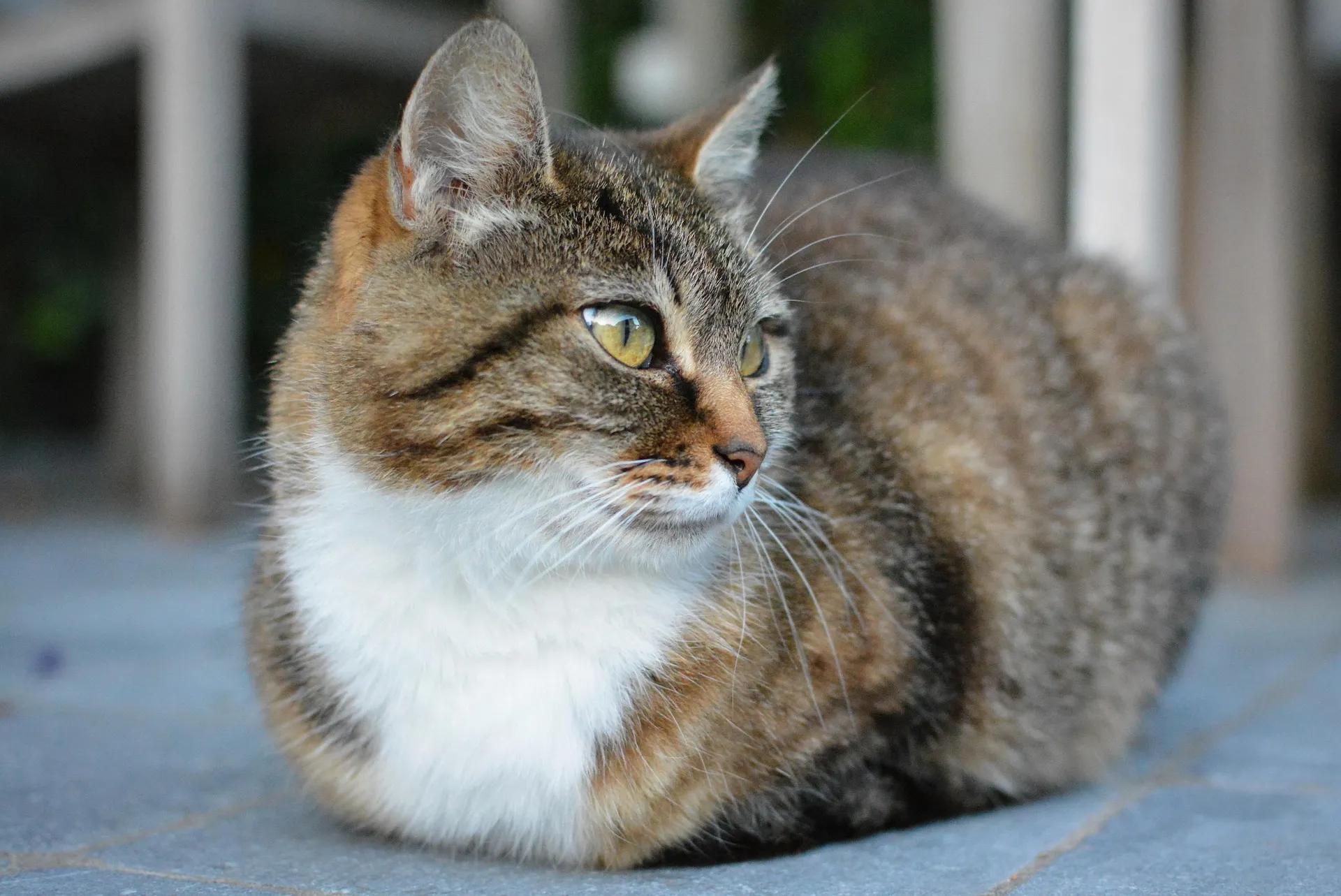
Here's what the scale roughly maps to [4]:
The target for most adult cats is BCS 5 out of 9 [4].
You can do a rough self-check at home in three steps [4]:
- Feel the ribs. Run your hand along your cat's side. You should feel the ribs under a thin layer of fat — not sharp, not buried.
- Check the waist. Look down from above. There should be a visible inward curve behind the ribs.
- Look at the belly. From the side, there should be a slight tuck.
A quick warning: cats have a normal "primordial pouch" — that loose flap of skin on the lower belly — which is not a sign of fat [4]. Don't mistake it for obesity. And because it's easy to underestimate your own cat, what feels like "fine" to you might read as a 6 or 7 to a vet.
Why it actually matters: the health risks
Okay, so your cat might be a pound or two over. Why does it matter? This isn't just about looks — extra weight in a cat is genuinely hard on their body.
Cornell lists the health problems associated with feline obesity, and they're serious [1]:
- Osteoarthritis — the joint cartilage erodes, and bones grind, causing real pain.
- Diabetes mellitus — obesity is one of the most important risk factors for diabetes in cats [5].
- Cardiovascular problems — extra weight burdens the heart and circulation.
- Hip dysplasia — in predisposed cats, excess weight worsens the joint malformation.
The thing is, cats hide pain incredibly well. A cat with arthritic joints won't complain — it'll just stop jumping quite as high, or sleep a little more, or move a little slower. And you might chalk that up to "getting older" when it's really weight-related joint strain.
That's why weight management matters. It's not vanity. It's one of the most preventable ways to protect a cat's quality of life.
Is your cat actually overweight? (And what to do)
So, how common is this? It's not rare — not by a long shot.
Cornell notes that roughly 50% of cats seen in veterinary clinics are overweight or obese [1]. And the Association for Pet Obesity Prevention's 2024 survey found that 33% of cat owners themselves describe their cat as overweight or obese — up from 28% the year before [6]. The gap between those two numbers is telling: owners tend to underestimate their cat's condition, while vets see a much bigger problem.
If you suspect your cat is overweight, here's the sane approach — and it's mostly about knowing when to involve a vet:
Start with a self-check, then confirm with a professional. Do the BCS rib/waist/belly check at home [4]. Then, at your next vet visit, ask for a Body Condition Score. It's quick and free, and it gives you a real number to track.
Don't crash-diet your cat. This is important. Cats are not dogs, and fast, drastic weight loss is genuinely dangerous — it can trigger hepatic lipidosis (fatty liver disease), which is a serious condition [4]. Weight loss in a cat should be gradual and ideally done under veterinary guidance.
The fix is usually simple, and slow. Portion control and more movement, done gradually, over weeks to months. If your cat needs to drop weight, your vet can help you figure out a safe target and pace — often it's less about a special diet and more about measuring food and adding daily play.
Rule of thumb: if your cat is heavy, watch for the signs of over-grooming pain, reduced jumping, or labored movement — but don't try to fix it with a starvation diet on your own. Talk to your vet.
The takeaway
Here's the one-line version: a 13-pound (6 kg) cat might be fine — or it might be genuinely overweight, and the scale alone can't tell you which.
For a typical house cat, 13 pounds sits past the top of the healthy range and, at 30% over a 10-pound ideal, lands firmly in what vets call obesity. The excess weight translates to the human equivalent of carrying an extra 30 to 45 pounds.
But the real judge isn't the scale — it's body condition. Learn the BCS check, get your vet's read, and treat weight as the health issue it is: a risk factor for diabetes, arthritis, and heart problems that's well within your power to address — slowly, safely, and with your vet's help.
Don't panic about the number. Pay attention to the body. That's where the truth lives.
Furpick.app is a participant in the Amazon Services LLC Associates Program and other affiliate programs. We may earn from qualifying purchases. Content from Amazon and other retailers is provided 'as is' and subject to change. All trademarks are the property of their respective owners.